
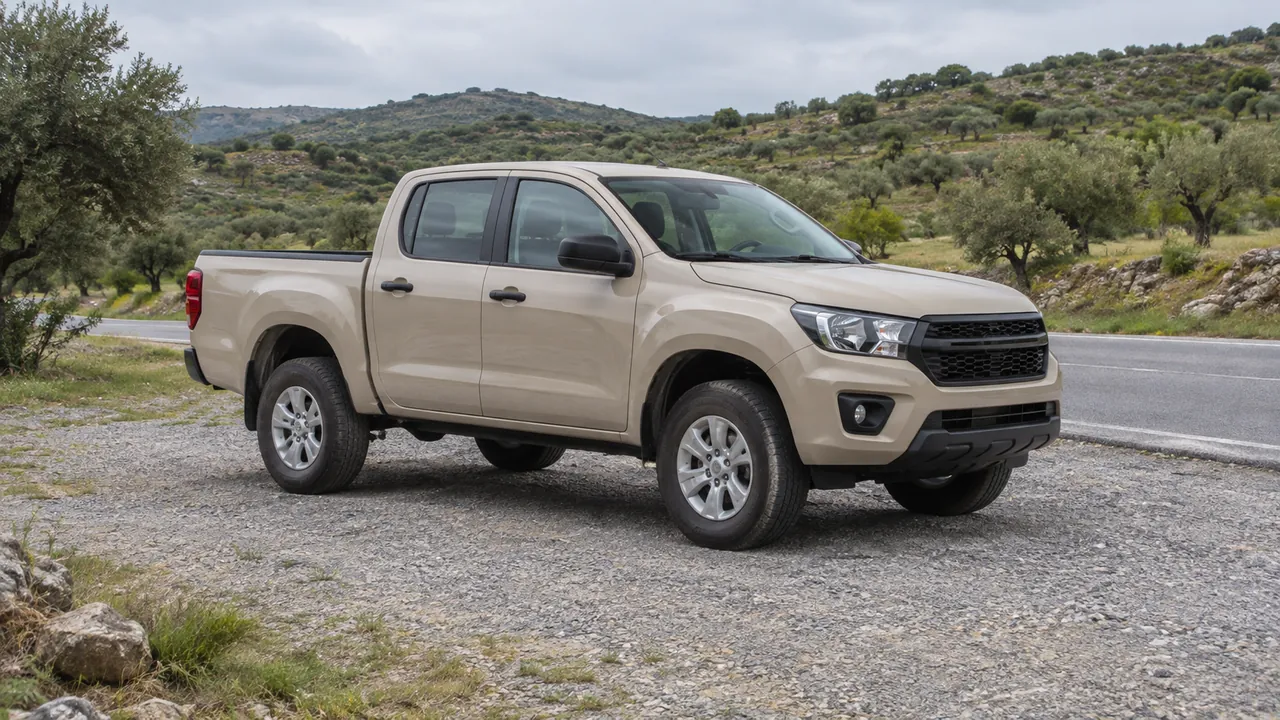
A pickup that spends its week on paved urban routes has a different job from one that must reach an unsealed site after rain. Before comparing 4×2 and 4×4 prices, write down where the vehicle will work, how often conditions change and which trips are essential. The decision should reflect the difficult part of a normal working year as well as the easy part.
What 4×2 and 4×4 tell you
A 4×2 pickup drives two wheels; a 4×4 system can drive all four. Those labels do not establish payload, towing capacity, braking distance, tyre suitability or clearance. Confirm those items separately for each quoted configuration.
The type of four wheel drive matters too. Mitsubishi’s Triton technical introduction distinguishes Easy Select from Super Select 4WD II and explains their different selector modes. Ask the supplier to name the installed system and supply the matching operating instructions. Do not assume a mode on one pickup is suitable for the same surface on another.
Build a route profile before comparing vehicles
Record the proportion of paved work, any loose or slippery sections, gradients, seasonal changes and access restrictions. Ask the people who drive those routes which locations cause delays or require another vehicle. Include the vehicle’s usual load and the conditions on the return trip.
Separate an occasional optional detour from access that is critical to a contract. A short unavoidable section can matter more than the percentage of kilometres spent on paved roads. Where practical, arrange a controlled assessment of a suitably specified vehicle on representative routes, within its operating limits.
Use this decision table as a starting point
| Work pattern | Option to investigate | Checks before ordering |
|---|---|---|
| Paved deliveries with predictable access | A suitable 4×2 configuration | Load limits, turning space, tyres and destination support |
| Regular loose or slippery site access | A suitable 4×4 configuration | Installed system, approved modes, clearance and driver training |
| Mixed fleet with only some difficult routes | Different configurations by assignment | Vehicle allocation, seasonal cover and backup arrangements |
| Heavy equipment or towing on any route | Compare exact load ratings first | Axle, vehicle, combination and towing limits |
| Remote work with costly interruptions | Assess access and service support together | Route evidence, recovery plan and parts availability |
This table helps structure an enquiry; it does not guarantee that a vehicle can complete a particular route. Ground conditions, tyres, driver decisions and the loaded vehicle all affect the assessment. Four wheel drive does not remove the need to avoid unsafe conditions.
Keep traction and load capacity separate
Do not select 4×4 as a substitute for checking the load. Obtain the actual payload, vehicle mass, axle and towing limits for both quotations, using the same cab, gearbox and equipment assumptions. Manufacturer specifications vary by grade: Mitsubishi’s Triton brochure lists different mass and payload figures across its Australian range. Those figures must not be transferred to a UAE export vehicle.
For your own assessment, include occupants, tools, permanently fitted accessories, cargo and any applicable trailer load. As a planning example only, 600 kg of cargo plus 225 kg of occupants and 120 kg of fitted equipment totals 945 kg before other applicable allowances. Check the manufacturer’s definitions and the exact unit’s limits rather than treating this example as an approved loading plan.
Compare operating costs using the same assumptions
Ask for comparable quotations with the same model year, cab, transmission, essential equipment, delivery scope and destination. Then compare purchase cost alongside fuel, scheduled servicing, tyres, insurance and likely support needs. Use actual manufacturer data and local service quotations where available; do not assume a fixed percentage saving for either drive system.
Include the business cost of missed access, a replacement vehicle or a delayed delivery. For a fleet, a mixed order may deserve investigation if only some assignments need four wheel drive. Record who will allocate those vehicles so the capability is available when needed.
Match driver training to the installed system
Have the handover explain the actual selector, permitted surfaces, switching procedure and any speed or stopping requirements in the owner’s manual. A driver accustomed to a different system should receive the instructions for the new vehicle. Mitsubishi’s Super Select guide is useful background, but the delivered vehicle’s manual remains the operating reference.
Check the proposed tyres, spare wheel and tools, service access and locally available replacement parts. Ask how any fitted canopy, toolbox or other accessory changes the finished vehicle’s weight and use. Keep this information with the fleet’s vehicle records.
Prepare your fleet drivetrain brief
Send the destination, quantities, routes, seasonal conditions, passenger and load needs, towing requirements and essential equipment with your enquiry. Request exact 4×2 and 4×4 configurations where a comparison is useful, with exclusions and availability stated clearly.
Browse the pickup inventory, compare the Hilux and L200, or use the import cost guide to build the wider budget. The downloadable worksheet below helps you record the route and load questions before asking for a quotation.